Why a dry arch holds
No mortar, no steel, no glue — and yet a well-made arch outlives the mason, the village and often the river.
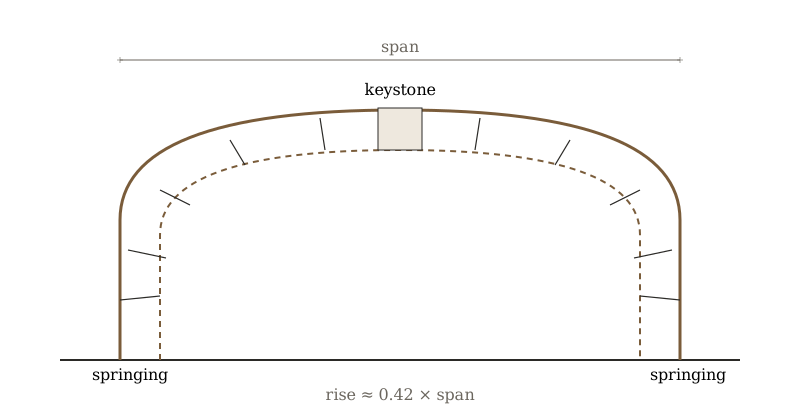
An arch works by turning the downward weight of everything above it into sideways push against its abutments. Each stone leans on its neighbour; the neighbour leans back. The resulting chain of forces is the thrust line, and the whole art is keeping that line inside the masonry from crown to springing.
The kitchen-table version
Take six hardback books of similar thickness. Stand them on their spines in a curve, leaning each against the next, with the two outer ones braced against something heavy. It takes a few attempts. When it holds, push gently down on the middle book: it gets firmer, not looser. That is the arch doing its job — load makes it stronger, up to a point.
Now take away one of the heavy braces. Everything falls at once. The abutments are not decoration.
Where it goes wrong
Arches rarely fail by crushing. They fail by hinging: the thrust line wanders outside the ring at some point, a joint opens, and the arch turns into a mechanism. Four hinges and it is a collapse. Three and it is a bridge with a worrying bulge that the county has been meaning to look at.
Scour at the foundations is the usual culprit, which is why old bridges are so often closed after floods even when they look unharmed from the road.